
The UK Flood Hydrology Roadmap was published by the Environment Agency in 2022, along with an action plan to achieve it. Developed by and for the UK flood hydrology community, it sets out a 25-year vision for flood hydrology in the UK, summarised as:
“Society has improved hydrological information and understanding to manage flood hazard in a changing world“
Successfully achieving this vision will require strong leadership, and improved partnership working and collaboration across the whole flood hydrology community.
The Roadmap lasts until 2046 and includes:
With an estimated cost of between £110 million and £165 million over its 25-year lifetime, delivering the Roadmap’s 31 actions would represent a significant investment in UK hydrology practices and information. The Roadmap does not come with its own funding, and it is expected that several different funding sources and programmes will contribute towards the Roadmap’s vision. The largest contribution to date has been the Environment Agency’s Flood Hydrology Improvements Programme, running from 2021 to 2027. The Scottish Environment Protection Agency, Natural Resources Wales and the Department for Infrastructure Northern Ireland have contributed financially to the administration of the Roadmap delivery including its governance groups and a communications and engagement plan, as well as in kind contributions to some of the Environment Agency’s projects.
Find out how your contribution can be acknowledged: the Roadmap badges.
Summary of the flood hydrology roadmap for the UK

As well as the need for flood hydrology to account for and predict the impacts of future environmental change (both climate change and land use change), the Roadmap also recognises:
the scale of investment underpinned by flood hydrology data, methods, models and expertise (around £6 billion over the next 6 years)
the need to support delivery of flood risk management strategies across the UK the need to improve partnership working and collaboration across the UK flood hydrology community
the need to improve the translation of hydrological science into practice
the need to deal with known limitations in existing operational flood hydrology methods the opportunity for flood hydrology to contribute to net zero carbon targets
the need to improve partnership working and collaboration across the UK flood hydrology community
the need to improve the translation of hydrological science into practice
the need to deal with known limitations in existing operational flood hydrology methods
the opportunity for flood hydrology to contribute to net zero carbon targets
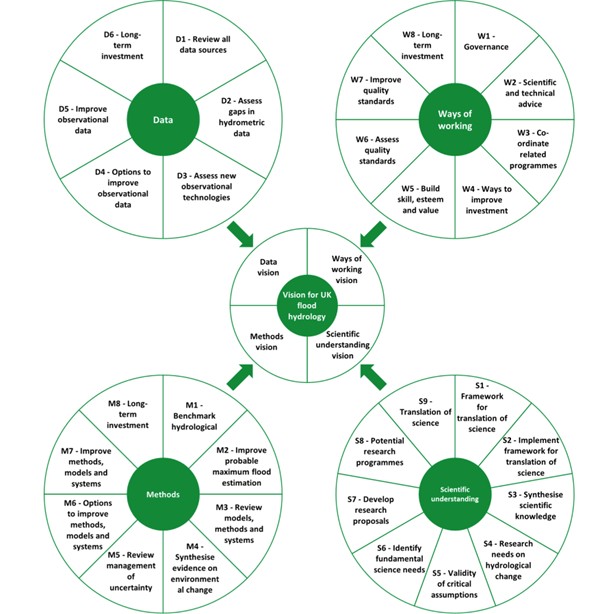
UK Flood Hydrology Roadmap actions, grouped around the central vision
Annual reports
- UKFHR Report 2024-25. This report covers the progress of the UK Flood Hydrology Roadmap between 1 April 2024 and 31 December 2025. It begins with a contextual overview of the Roadmap, outlining its mission, purpose, and the organisations involved in its governance and delivery. This is followed by a detailed account of Roadmap delivery during the reporting period, structured around the Roadmap’s core themes.
- UKFHR Report 2022-24. This report covers the progress of the UK Flood Hydrology Roadmap between 1 April 2022 and 31 March 2024. The report begins with contextual summary of the Roadmap, covering its mission, purpose and who is involved in its delivery. It then provides an overview of performance against key activities, covering the work undertaken during this period and notable successes that have been achieved. Communications and engagements we have undertaken are also summarised.
Communications
Below are links to videos from some BHS webinars on the Roadmap.
- March 2024: Flood Hydrology Roadmap Update. 26/03/24 Webinar
- June 2022: The UK Flood Hydrology Roadmap – Next Steps
- March 2021: A flood hydrology roadmap for the UK: Delivery plan for the first 7 years
The Roadmap has also reported been reported periodically in Circulation
Governance Board
The delivery of the Roadmap is overseen by a Governance Board (GB). It comprises representatives of the lead flood agencies from each of the UK’s four nations – the Environment Agency, Natural Resources Wales, Scottish Environment Protection Agency and the Department for Infrastructure in Northern Ireland. The GB also has representatives from the BHS, UK Research and Innovation and the STAG (see below).
The role of the GB includes promoting the Roadmap vision, identifying funding opportunities, encouraging participation and reporting on progress to the hydrological community. Membership of the GB may expand as the Roadmap develops and other sources of funding are identified. Terms of reference of the GB are here.
Scientific and Technical Advisory Group (STAG)
The role of the STAG is to (i) help to shape and scope projects and initiatives to implement the Roadmap; (ii) provide scientific and technical advice and steer to in-flight Roadmap projects; and (iii) provide peer review of project outputs prior to publication. The STAG plays a crucial role in the governance of the UKFHR and reports directly to the Governance Board (GB). Full terms of reference of the STAG are here.
Since its inception in January 2023 the STAG has:
- Worked together to build a proactive and inclusive working structure for the STAG
- Considered opportunities to collate current activity in hydrological research and innovation across the UK
- Engaged with ongoing projects including FHIP activity on benchmarking hydrological models and data rescue, HydroJULES and FDRI
- Supported the UK Hydrology Skills Survey
- Reviewed opportunities for the development of standards and guidance within flood hydrology
- Co-led a workshop with the Environment Agency FHIP team at the BHS 2024 conference to explore challenges and opportunities in translating new science into operational methods
- Worked with the GB to initiate research activity to improve understanding of hydrological processes in a changing climate
- Actively promoted the Roadmap through conference, webinars, blogs, newsletters and scientific papers
Membership of the STAG rotates every 2-3 years. The current members are:
- Tom Willis – Environment Agency
- Emma Bruce – Scottish Environment Protection Agency
- Martin Best – Met Office
- Jo Cullen – Welsh Water
- Steve Cole – UKCEH
- Matthew Cowdell – JBA Consulting
- Chris Skinner – Environment Agency FHIP
- Liz Lewis – Manchester University
- Nigel Wright – Birmingham University
- Jiren Xu – Glasgow University
- Martyn Roberts -James Hutton Institute
- Christopher Masafu – Gallagher Re
- David Hughes Arthian
- Jonathan Mackay – BGS
- Steve Cole – UKCEH
- Owain Sheppard – Natural Resources Wales
- Will Rust – Atkins
- Linda Speight – University of Oxford (outgoing chair)
How you can get involved: the Roadmap badges!
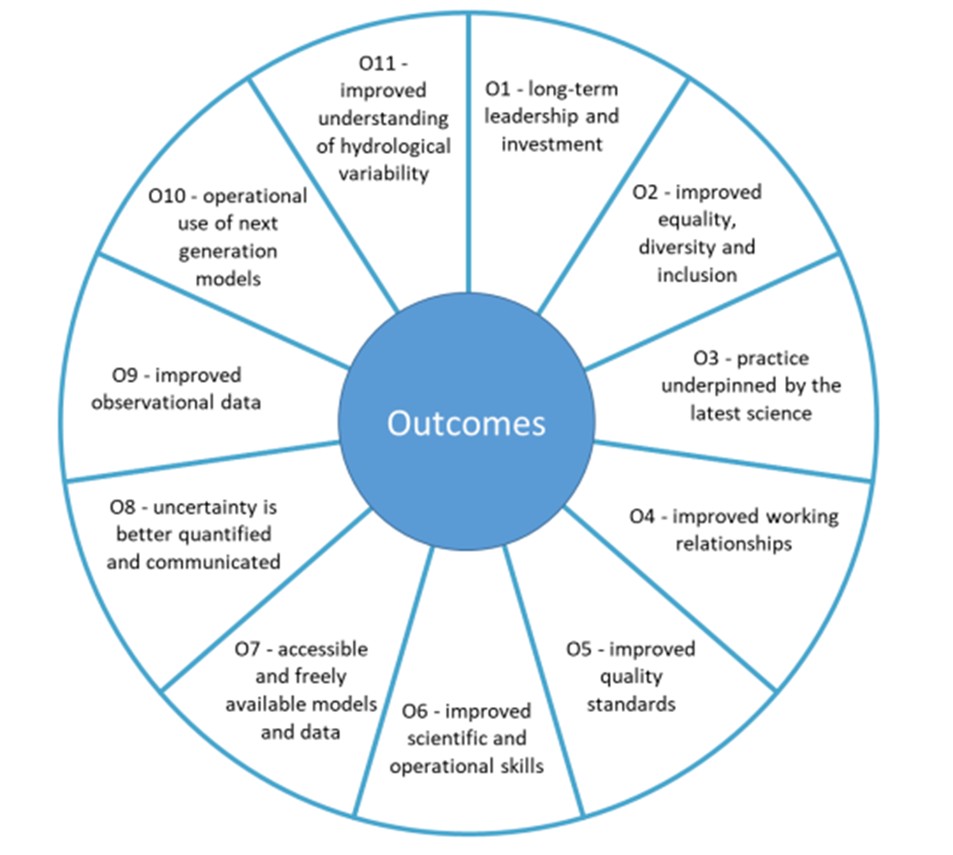
Many people are working towards a better future in flood risk management. We’d like to recognise all contributions towards the Flood Hydrology Roadmap vision and outcomes. By using these badges to highlight where work is aligned to the UK Flood Hydrology roadmap vision we can: make sure important work and findings are found by others; more easily identify where gaps still exist, and importantly; help researchers or practitioners gain recognition for the wider importance of their work to the UK in managing flood risk.
There are 11 outcomes identified by the UK flood hydrology roadmap (see the full report here).
f you’d like to use these badges to show how your work is contributing to UK hydrology for flood risk management, you’ll be invited to complete a UK Flood Hydrology Roadmap badges – Collaboration form. The short form asks for a brief description of your project or initiative and how it aligns with the Roadmap. Approved badges may be displayed on reports, technical guidance, research papers, journal articles, conference presentations, webinars, digital content, websites, training materials, datasets and other hydrological outputs to demonstrate how the work contributes to the UK Flood Hydrology Roadmap vision and outcomes
On submission of the form, the appropriate badges will be available for you to download free of charge and use with your reports, presentations, or other outputs. Completion of the form also helps the Flood Hydrology Roadmap Governance Board and Scientific and Technical Advisory Group be sighted on where and how the badges are being applied and how projects across the hydrological community align with the 11 outcomes.